New Afrikaans Political Party on the Horizon? Secret Meeting Raises Questions for FF Plus
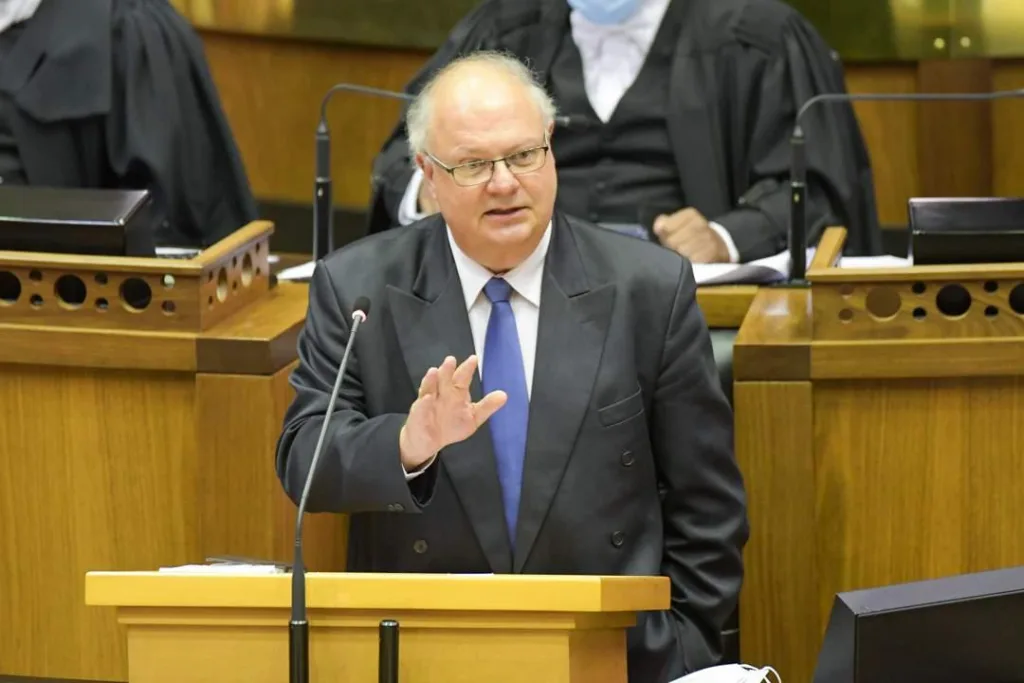
Freedom Front Plus leader Corne Mulder speaking in Parliament.
FF Plus leader Corne Mulder confirms discussions about a potential new party, raising questions about Afrikaans political representation ahead of the 2029 elections.
DURBAN, South Africa — 29 October 2026: A reported behind-the-scenes meeting in Johannesburg has raised questions about the future of Afrikaans political representation in South Africa, with Freedom Front Plus (FF Plus) leader Corne Mulder confirming that discussions about establishing another party took place earlier this month.
The meeting was held in Fourways on 6 October, according to Mulder, who revealed its existence during a televised discussion with political analyst Professor Koos Malan on KykNet’s In Gesprek. What remains unclear is who attended the meeting, what was discussed in detail, and whether those involved intend to take the idea beyond preliminary discussions.

The revelation comes amid a broader debate about the FF Plus’s direction and whether the party can expand its political reach without weakening the identity on which it was founded.
Is the FF Plus Moving Away From Its Roots?
During the discussion, Malan questioned whether the FF Plus was drifting away from its traditional role as a party focused primarily on Afrikaans-speaking and Afrikaner interests.
His argument centred on the party’s apparent shift toward a broader opposition strategy, including participation in coalition politics and efforts to attract support from people outside its traditional constituency.
According to Malan, this approach risks changing the party’s original political purpose. He compared the situation to the transformation of the former National Party under leaders such as FW de Klerk, Roelf Meyer and Marthinus van Schalkwyk.
Mulder rejected that comparison, maintaining that the FF Plus remains firmly grounded in Afrikaner interests and a Christian, centre-right political philosophy.
He argued that attracting supporters from different cultural backgrounds does not necessarily mean abandoning the principles that define the party. Those principles include private property rights, limited government, decentralisation, self-determination and minority rights.
The disagreement highlights a challenge facing political movements across the spectrum: how do they broaden their support without alienating the voters who built them?
A New Party Could Change the Political Equation
Mulder’s comments about the Fourways meeting added another dimension to the debate.
He confirmed that discussions had taken place about establishing a separate political party, potentially positioning it to compete with the FF Plus in the 2029 national elections.
Although he expressed no objection to people establishing a new party, Mulder questioned whether another party serving a similar constituency would be beneficial at a time when opposition parties are seeking to challenge the ANC’s political dominance.
His concern is that splitting voters who share broadly similar political objectives could weaken their collective influence.
Malan, however, said he knew nothing about the meeting and challenged Mulder to explain what he knew. The exchange left important questions unanswered, particularly regarding the identity of the organisers and whether a formal political movement is actually being developed.
At this stage, the available information does not establish that a new party has been formed or that the meeting produced a concrete decision to proceed.
Representation, Identity and Political Strategy
The debate raises a bigger question about the role of identity in South African politics.
For some voters, a party dedicated to protecting Afrikaans language rights, cultural heritage and minority interests offers a necessary political voice. Others may argue that these objectives can be pursued more effectively through a broader movement capable of influencing government policy and participating in coalitions.
Neither approach is without its challenges.
A narrowly focused party may struggle to expand its electoral influence, while a party that broadens its appeal risks diluting the priorities that initially attracted its supporters.
The FF Plus is attempting to demonstrate that these objectives are not mutually exclusive. Mulder maintains that the party can welcome supporters from different backgrounds while retaining its established principles.
Whether voters agree with that assessment is another matter.
The emergence of a potential rival could test the strength of that position, particularly if its organisers believe the existing political landscape does not adequately represent their interests.
However, without knowing who attended the Fourways meeting, what political platform they discussed or whether they intend to register a party, it would be premature to draw firm conclusions about its likely impact.
The Questions That Remain
South Africa’s political landscape is already shaped by coalition negotiations, shifting voter loyalties and the search for alternatives to established parties. A new Afrikaans political movement could add another player to that environment, but its significance would depend on more than the circumstances surrounding a private meeting.
Its leadership, policy proposals, funding, electoral ambitions and willingness to cooperate with other opposition parties would ultimately determine whether it could gain meaningful support.
There is also the question of whether a new party would offer voters a genuinely different political programme or simply divide an existing support base between competing organisations.
For now, the Fourways meeting has generated more questions than answers.
Will a new party emerge to challenge the FF Plus, or will the discussions remain an exploratory exercise? Is the FF Plus successfully broadening its appeal while protecting its founding principles, or is it moving away from the constituency it was established to represent? And, ultimately, would another political party strengthen Afrikaans representation in South Africa or fragment its electoral influence?
Source: Newsday — “Secret meeting to start a new Afrikaans party in South Africa”.