Farmer Brutally Tortured in North West Farm Attack
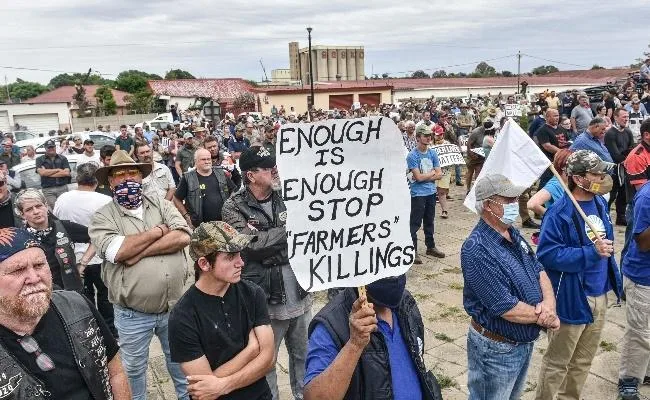
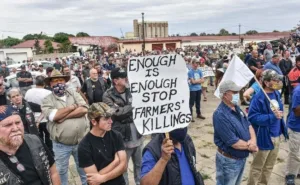
Demonstrators gather to protest against farm murders in South Africa, demanding greater protection for farming communities. The placard reads: "Enough Is Enough – Stop Farmers' Killings."
Donovan Marx shot, stabbed, and mutilated in another horrific attack. Where is the mainstream media?
SOUTH AFRICA — 30 October 2026: A 50-year-old cattle farmer is recovering in hospital after an extraordinarily brutal attack on his farm between Potchefstroom and Ventersdorp in North West. He was shot in the back, stabbed, tortured, and had both ears cut off.
His name is Donovan Marx.
A farmworker was also tied up during the attack but managed to free himself and raise the alarm.

The reported details are deeply disturbing. This was not simply a case of criminals entering a property and stealing livestock or valuables. According to reports, Marx was subjected to horrific violence, leaving him seriously injured and requiring emergency medical treatment.
Yet beyond the initial reports, another question deserves attention: why do farm attacks and farm murders continue to struggle for consistent national media coverage?
This latest incident is not happening in isolation. It adds to an established pattern of violent crime affecting South Africa’s farming communities, where residents often face particular security challenges because of their distance from emergency services and police resources.
The brutality of this attack deserves attention. So does the wider problem it represents.
What Happened to Donovan Marx?
The attack took place on Wednesday, 28 October 2026, on Marx’s cattle farm between Potchefstroom and Ventersdorp.
According to reports, the attackers struck after a family member had left for work shortly before 08:00.
A farmworker was allegedly restrained while the attackers turned on Marx.
The farmer was shot in the back, stabbed in the leg and subjected to horrific torture. Both his ears were reportedly cut off.
He was transported to Mediclinic Potchefstroom, where he received emergency medical treatment.
His family subsequently indicated that he was stable and had undergone surgery.
The suspects reportedly fled in his red Isuzu bakkie, prompting a police investigation.
Agriculture Minister Willie Aucamp condemned the attack, acknowledging the vulnerability of rural communities because of their isolation and the difficulty of accessing immediate assistance.
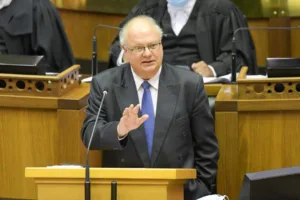
Parliament’s Portfolio Committee on Police chairperson Ian Cameron also condemned the incident, highlighting the need for specialised policing and a more focused response to farm attacks.
The circumstances raise serious questions about the level of violence involved and the safety of people living and working on isolated agricultural properties.
Another Attack. Another Family Affected.
Marx’s ordeal comes less than a month after the murder of 55-year-old Hannetjie van Zyl, who was attacked near the entrance to her farmhouse outside Ottosdal on 5 October.
Van Zyl was reportedly assaulted with an iron bar and suffered fatal head and neck injuries.
She died while being transported to hospital.
These are two separate incidents, but both demonstrate the vulnerability of people living in rural communities.
One family is now dealing with the consequences of a brutal attack that left a farmer seriously injured. Another has lost a loved one.
How many such incidents must occur before rural safety becomes a consistent national priority?
Farm Murders Are a Problem. The Statistics Cannot Be Dismissed.
There is an ongoing argument about the terminology, classification and motivation behind farm attacks.
But there should be no argument about whether these crimes exist.
AfriForum’s 2025 report recorded 184 farm attacks and 29 farm murders during the year. Its corresponding figures for 2024 were 176 attacks and 37 murders.
These are independently compiled figures and should not be confused with an official SAPS farm-murder category.
The Institute for Security Studies has also acknowledged that farm attacks constitute a serious crime problem requiring focused attention.
One can disagree with claims that farm attacks constitute genocide. One can question the motives attributed to individual incidents. One can challenge statistics and demand better methodology.
But none of those disagreements makes the crimes themselves disappear.
There is no requirement to establish a politically motivated campaign before acknowledging the suffering of farmers, farmworkers and their families.
The question is not whether every attack has the same motive. It is whether South Africa is doing enough to prevent these crimes, investigate them and bring perpetrators to justice.
Where Is the Mainstream Media?
This is where the conversation becomes particularly uncomfortable.
A review of searchable South African news coverage on 30 October identified reporting on the Donovan Marx attack by TimesLIVE, The South African, Newsday, the Potchefstroom Herald and OFM.
Those publications deserve acknowledgement for covering the incident.
However, I could not locate corresponding reports specifically covering the Marx attack on the websites of several prominent national outlets, including News24, eNCA, SABC News, Daily Maverick and IOL at the time of this review.
That absence raises legitimate questions about editorial priorities.
A farmer has allegedly been shot, stabbed, tortured and mutilated. These are extraordinary circumstances surrounding a violent crime. Why is there not a more visible national conversation about what happened?
Why does an incident of this severity not receive consistent attention across the country’s major newsrooms?
Would the same editorial decisions be made if the victim belonged to a different community?
The issue is not that every publication must report every crime. Newsrooms make decisions about resources, relevance and public interest.
But when certain categories of crime appear to receive less sustained attention, the public is entitled to ask why.
Reporting an incident is one thing. Investigating the wider problem, following up on police investigations and examining the effectiveness of government interventions is another.
South Africa needs both.
Condemning Those Who Speak While Overlooking the Crimes?
There is another contradiction in the wider discussion surrounding farm murders.
When individuals, organisations and commentators raise concerns about farm attacks, they can find themselves accused of exaggerating the problem, promoting racial division or advancing a political agenda.
Some claims deserve scrutiny. Unsupported allegations must be challenged, and journalists have a responsibility to distinguish evidence from speculation.
But why is the same determination not consistently directed towards examining the crimes themselves?
Why does the conversation so frequently become about the people discussing farm murders rather than the victims?
The suggestion that there is no such thing as farm murders cannot be reconciled with documented attacks, killings, police investigations and government condemnations.
The terminology may be debated. The statistics may be challenged. The motives may differ.
But the victims are real.
And Donovan Marx is another reminder of that reality.
Journalism Must Follow the Evidence
South Africa’s media has a responsibility to investigate violent crime, regardless of the victim’s occupation, background or circumstances.
That responsibility includes asking difficult questions of government, SAPS and political leaders.
Are rural communities receiving adequate protection? Are investigations resulting in convictions? Are police resources sufficient? Is the National Rural Safety Strategy being implemented effectively?
Most importantly, are the experiences of farming communities receiving the same consistent investigative attention afforded to other serious crime issues?
Farmers and farmworkers are entitled to the same protection, dignity and justice as every other South African.
The country’s agricultural economy and food security are also affected when people live and work under the threat of violent crime.
This should not be a politically divisive issue. Protecting people from violent criminals should be a common objective.
The Questions That Remain
Donovan Marx should not become another name that briefly attracts headlines before disappearing from public consciousness.
His recovery matters. His family deserves answers. The farmworker who survived the attack deserves recognition. And the people responsible must be brought before the courts.
But the wider issue must not disappear with the news cycle.
South Africans should be able to discuss farm murders without being immediately drawn into arguments about political allegiance, race or international propaganda.
We should be able to demand accurate statistics, better policing, accountability and consistent media coverage without having to justify why these victims deserve attention.
If a farmer is brutally tortured, shot and mutilated, surely the public has a right to know. Surely the incident deserves more than a passing mention.
And if major publications have chosen not to report it, the public has every right to question those editorial decisions.
How many more farmers and farmworkers must become victims before farm attacks are treated as a national priority? Why is acknowledging farm murders still such a contentious issue? And when newsrooms decide which stories deserve national attention, who holds them accountable for what they choose not to cover?