The Digital ID Trap: Are We Trading Minor Fraud for Total State Control?
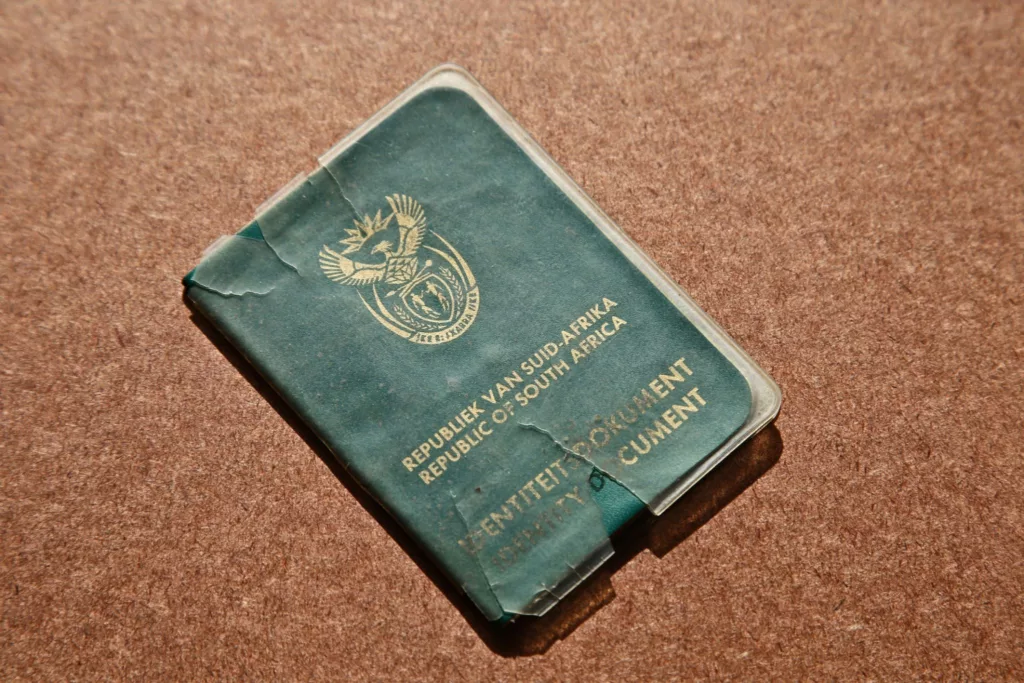
An old South African Identity book (ID book) on top of a wooden table top.
We all know the dread of standing in a Home Affairs queue. It is a uniquely South African experience of frustration, offline systems, and bureaucratic red tape. So, when Minister Leon Schreiber and President Cyril Ramaphosa promise to make our lives easier by phasing out the old green ID book in favor of a sleek, smartphone-based “Digital ID,” it sounds like a relief.
We are told the green ID is “vulnerable and fraud-prone”—a relic of the past that must be discarded to stop identity theft and secure our borders.
But if we look past the high-tech marketing, a much more worrying question emerges: Are we being asked to hand the state the ultimate tool for surveillance and control, all under the guise of “modern convenience”?

Trading Localized Risks for National Catastrophe
The government’s main argument is that the green ID book is too easy to forge. While it is true that physical documents can be manipulated, the risk they carry is strictly localized.
If a criminal alters a physical green ID, they commit a manual, isolated crime. They cannot hack a paper book from a computer terminal halfway across the world. The damage is contained to that single document.
A centralized Digital ID, however, changes the game entirely. By consolidating the biometrics, facial scans, and personal histories of 60 million citizens into one massive digital database—as outlined in the Department of Home Affairs’ plan for an “Intelligent Population Register”—the state is building a giant target for hackers, hostile states, and corrupt insiders.
If a hacker breaches a physical file cabinet, they get a few papers. If they breach the government’s digital vault, they steal millions of identities in a single keystroke. And unlike a leaked password, you cannot reset your face or your fingerprints. Once your biometric data is stolen, your identity is permanently compromised.
When “Voluntary” Becomes Mandatory
The Department of Home Affairs insists this new system is completely voluntary. But we have seen this play out globally, and “optional” digital IDs are almost always a myth.
Look at what happened in India with its Aadhaar biometric system. It started as a voluntary way to access services. Within years, banks, telecom companies, and employers defaulted entirely to the digital database.
As documented by the indigenous health and human rights watchdogs and reported in The Hindu, citizens who opted out—or marginalized laborers whose fingerprints were too worn down from hard work to register on the scanners—found themselves completely locked out of basic bank accounts, mobile networks, and even lifesaving food subsidies, leading to documented cases of starvation.
We are already seeing the same playbook in the UK. Prime Minister Keir Starmer recently announced plans to link digital IDs directly to the “right to work” to crack down on illegal immigration. Though public backlash eventually forced the government to back down on making the card compulsory, the intent remains clear.
How long before South Africans face the exact same ultimatum? What starts as a convenient choice on your smartphone can quickly become a system where you are functionally locked out of daily life if you refuse to comply.
Systemic Failure in a Fragile State
Beyond the privacy concerns, there is a massive practical flaw. South Africans are all too familiar with what happens when our state infrastructure relies on a single point of failure.
When the Department of Transport relied on just one machine to print the entire country’s driver’s licenses, the machine broke down and left a backlog of hundreds of thousands of motorists stranded. Now, Home Affairs wants to discard the green ID printing machinery entirely in 2026.
In a country dealing with load-shedding, municipal water crises, and fragile telecommunications networks, relying entirely on real-time digital servers to prove your identity is incredibly reckless. If the network tower is down or the grid is offline, you are left unable to prove your legal existence to a police officer, a bank teller, or a border agent.
The Infrastructure of a Surveillance State
At its core, a centralized Digital ID builds the perfect runway for a surveillance state. Every time your digital ID is pinged—to open an account, buy a SIM card, register a business, or pass a checkpoint—a digital breadcrumb is left behind.
While current leaders promise they would never abuse this power, we must look at the architecture being built. Once a government possesses a centralized, real-time tracking tool of its citizens, the temptation for “function creep” is historically irresistible.
Are we comfortable building a system that gives future administrations the turnkey capability to monitor, track, and potentially restrict our access to society?
Modernization is inevitable, but it shouldn’t cost us our freedom. Before we hand over our biometrics and sign up for a digital cage, we need to ask: Is this system actually designed to protect us, or is it designed to manage us?
Take Action: Have Your Say
Civil society is pushing back to ensure South Africans retain their right to privacy and offline alternatives.
-
Object officially: Add your name to the formal submission opposing the centralized Digital ID regulations through the Lex Libertas Objection Form.
-
Join the movement: To learn more about defending your civil liberties and privacy, visit libertas.org.za.