South Africa’s 2026 Local Elections: ANC Remains Largest Party as Coalition Politics Takes Centre Stage
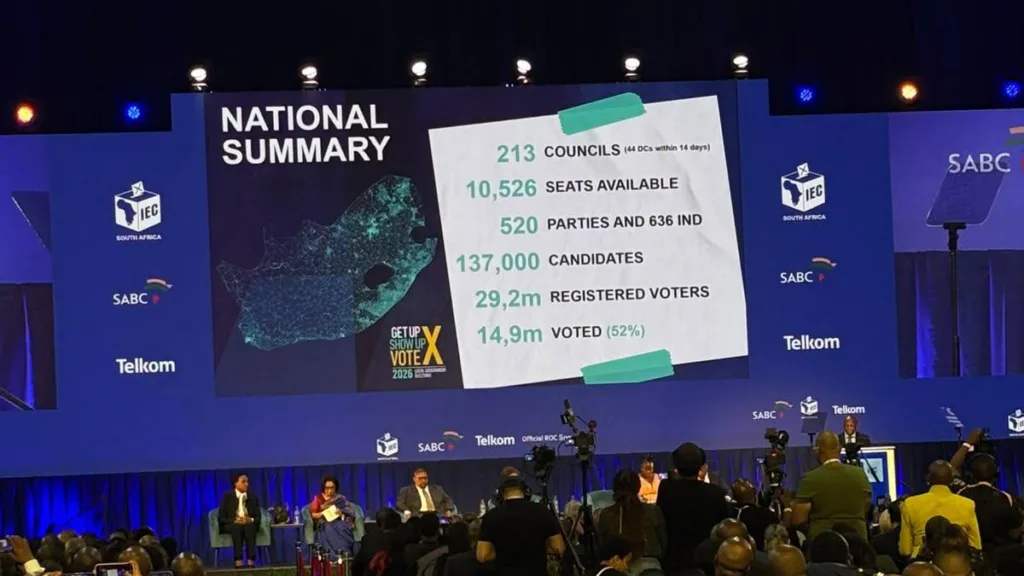
The Electoral Commission of South Africa presents the national summary of the 2026 local government elections.
The ANC retains its position as South Africa’s largest party, but declining support and fragmented opposition leave 139 municipal councils facing coalition negotiations
Johannesburg — 9 November 2026: South Africa’s 2026 local government election results have delivered a significant political setback for the African National Congress (ANC), while the Democratic Alliance (DA), uMkhonto weSizwe (MK) Party, Economic Freedom Fighters (EFF) and ActionSA face an increasingly complicated political landscape. With the ANC securing 30.76% of the national vote, the results demonstrate a substantial decline in its electoral support, while opposition parties have gained ground without establishing a single dominant alternative. According to Newsday’s final election results, the outcome leaves 139 municipal councils requiring coalition arrangements, raising questions about political stability, municipal accountability and whether the changing balance of power will translate into improved service delivery.
2026 Local Government Election Results
The Electoral Commission of South Africa (IEC) announced the final results following local government elections held between 2 and 4 November 2026.

Newsday reports that 29.2 million voters were registered, with approximately 14.9 million participating, representing a turnout of 52%.
The elections involved 520 political parties, 137,000 candidates and 213 municipal councils, with 10,526 council seats available.
The national results placed the ANC first, followed by the DA, MK Party, EFF and ActionSA.
According to Newsday, the leading parties recorded the following national vote shares and council seats:
| Political Party | National Vote Share | Council Seats |
|---|---|---|
| African National Congress (ANC) | 30.76% | 3,246 |
| Democratic Alliance (DA) | 24.64% | 1,695 |
| uMkhonto weSizwe (MK Party) | 9.76% | 785 |
| Economic Freedom Fighters (EFF) | 6.22% | 588 |
| ActionSA | 5.67% | 313 |
The figures establish that the ANC remains the largest party nationally, but its support is considerably lower than the level required to secure outright majorities across most municipal councils.
The DA remains the second-largest party, while MK has established itself as a significant electoral force. The EFF and ActionSA retain representation, although their national vote shares are considerably smaller.
The results also demonstrate that opposition support remains divided among several parties.
Rather than producing a clear national replacement for the ANC, the election has created a more fragmented political environment in which coalition negotiations will determine municipal leadership.
The ANC: Still the Largest Party, but Facing a Serious Electoral Setback
The ANC secured 30.76% of the national vote and 3,246 council seats.
Although it remains the largest party, the result represents a substantial departure from its previous electoral dominance.
Newsday reports that the ANC leads in 128 municipalities and secured outright majorities in 53.
These figures demonstrate that the party retains considerable political influence and an established presence across the country.
However, its national vote share raises questions about whether the ANC can recover the confidence of voters who have shifted their support elsewhere.
The decline comes after years of criticism concerning municipal service delivery, infrastructure failures, corruption allegations and the management of public resources.
Reuters reported that the ANC received 30.76% of the vote, compared with 45.59% in the 2021 local government elections. The news agency described the outcome as a major setback for the governing party.
The decline is significant, but the national results alone cannot establish why individual voters chose other parties.
Some voters may have been dissatisfied with municipal administration, while others may have been motivated by national political issues, leadership concerns or ideological differences.
The results demonstrate declining support. They do not establish a single explanation for that decline.
The question now is whether the ANC will respond with meaningful changes in governance and municipal performance, or whether it will attempt to recover support through political messaging without addressing the underlying concerns of voters.
The DA: Electoral Gains and the Challenge of Coalition Government
The DA secured 24.64% of the national vote and 1,695 council seats.
Newsday reports that the party leads in 32 municipalities and secured outright majorities in 12.
Its position as the second-largest party nationally demonstrates that it remains a significant political force.
However, the DA’s national vote share does not establish that it has secured control of the country’s major municipalities.
Municipal leadership depends on local council results, the distribution of seats and the ability to secure support from other parties.
The DA may therefore find itself negotiating with parties whose political positions differ considerably from its own.
Coalition arrangements could provide opportunities to establish alternative municipal leadership, but they also introduce the possibility of political instability.
The party’s challenge is to demonstrate that its electoral gains can translate into measurable improvements in municipal administration.
Winning votes is one part of the process. Maintaining functioning councils, managing municipal finances and delivering services will determine whether those gains produce lasting political support.
MK Party: A Significant Electoral Force
The MK Party secured 9.76% of the national vote and 785 council seats.
Former president Jacob Zuma’s party finished third nationally, establishing a significant presence in the country’s local government elections.
Its performance is particularly relevant in KwaZulu-Natal, where the party has challenged the ANC’s historical political dominance.
However, its national vote share remains considerably below that of both the ANC and the DA.
The result demonstrates electoral influence, but it does not establish that MK has become a national governing alternative.
Its ability to influence municipal leadership will depend on the number of seats it holds in individual councils and the political arrangements it can negotiate.
The party’s historical connection to the ANC also raises questions about the extent to which its electoral support represents a rejection of the ANC, support for MK’s own political programme, or a combination of both.
Those questions cannot be answered through national vote shares alone.
The next test will be whether MK can demonstrate effective municipal governance and translate its electoral support into practical improvements for residents.
EFF: A Smaller National Share and Questions About Its Political Direction
The EFF secured 6.22% of the national vote and 588 council seats.
Its result places it behind MK, the DA and the ANC, while demonstrating that the party retains representation in municipal politics.
The national figures raise questions about the EFF’s ability to maintain its position as a major challenger to the ANC.
However, the results alone do not establish why the party’s support has declined.
It would be premature to attribute its electoral performance exclusively to leadership decisions, policy positions, coalition arrangements or competition from MK without examining municipality-level results and voter behaviour.
The EFF’s future political influence will depend partly on whether it can demonstrate that its policies offer practical solutions to municipal challenges.
The party has an opportunity to examine its electoral performance and determine whether its political strategy continues to resonate with voters.
The question is whether it can rebuild support through effective political engagement and municipal performance, or whether its influence will increasingly depend on coalition negotiations.
ActionSA: Smaller National Support, Potentially Significant Coalition Influence
ActionSA received 5.67% of the national vote and secured 313 council seats.
Although its national support is smaller than that of the ANC, DA and MK, its position could become important in municipalities where no party has secured an outright majority.
The election has created opportunities for smaller parties to influence municipal leadership and policy decisions.
However, coalition influence should not be confused with electoral dominance.
ActionSA’s ability to shape municipal government will depend on the number of seats it holds in individual councils, the alternatives available to larger parties and the conditions it places on coalition agreements.
The party will also face questions about whether entering coalitions with parties it has previously criticised could undermine its political identity.
Coalition participation may provide an opportunity to influence municipal administration, but it also requires compromises.
The central issue is whether ActionSA can demonstrate that its participation produces identifiable improvements in service delivery, accountability and municipal governance.
Coalition Government: The Election’s Most Significant Consequence
The most consequential figure in Newsday’s report may be the number of municipal councils requiring coalition arrangements.
According to the article, only 74 of South Africa’s 213 municipal councils returned an outright majority for a single party.
The remaining 139 councils require coalitions.
The ANC leads in 128 municipalities and secured outright majorities in 53, while the DA leads in 32 municipalities and secured outright majorities in 12.
These figures indicate that political negotiations will play a substantial role in determining municipal leadership.
Coalitions can provide an opportunity for parties to cooperate on practical issues despite ideological differences.
They can also produce instability when parties disagree over mayoral appointments, budgets, policy priorities or the allocation of political positions.
The outcome will depend on the terms of individual coalition agreements and whether participating parties can maintain their commitments.
The central question is whether these coalitions will prioritise municipal administration and service delivery, or whether political bargaining will become the dominant concern.
A coalition that secures political control but cannot maintain a functioning council would offer little practical benefit to residents.
Conversely, arrangements that establish clear responsibilities, transparent decision-making and measurable performance standards could provide an opportunity to improve local government.
The election has created the conditions for both outcomes.
What the Results Establish — and What Remains Unanswered
Newsday’s report provides a useful overview of the national election results.
It identifies the leading parties, records their national vote shares and council seats, and explains the extent of coalition requirements.
However, the national figures do not provide a complete explanation of the political changes taking place.
National Vote Shares Do Not Explain Municipal Performance
National vote shares provide a broad picture of political support.
They do not establish which parties will govern individual municipalities.
A party can receive a relatively small national vote share while holding enough seats in a particular municipality to influence its leadership.
Likewise, a party with a strong national result may fail to secure a majority in a strategically important city.
Municipality-specific results are therefore necessary to assess the practical implications of the election.
The Results Do Not Establish Why Voters Changed Their Support
The figures show how votes were distributed.
They do not establish whether voters were motivated by corruption concerns, service delivery failures, unemployment, ideological differences, dissatisfaction with leadership or other factors.
Those explanations require additional evidence, including voter surveys, local reporting and comparisons with previous elections.
It would be misleading to treat the decline in ANC support as proof that every voter rejected the party for the same reason.
Coalition Requirements Are Not Coalition Outcomes
Newsday identifies 139 councils requiring coalitions.
That is an important distinction, but it does not establish which coalitions will emerge or whether those arrangements will remain stable.
The eventual political agreements will determine who controls municipal budgets, leadership appointments and policy decisions.
Those outcomes require further reporting.
Electoral Results Do Not Establish Future Governing Performance
The election provides evidence of voter preferences.
It does not establish whether the parties that gained support will govern effectively.
That assessment will require examining municipal finances, service delivery, infrastructure maintenance, accountability and the performance of newly formed coalitions.
The political significance of the election will ultimately be determined by what happens after the results are announced.
Conclusion: A Political Shift, but Not Yet a Clear Alternative
South Africa’s 2026 local government elections have weakened the ANC’s electoral position while increasing the influence of opposition parties.
The ANC remains the largest party nationally, but its 30.76% vote share demonstrates that it can no longer rely on the level of support it previously enjoyed.
The DA has retained its position as the second-largest party, while MK has established itself as a significant political force. The EFF and ActionSA retain electoral representation, although their national vote shares remain comparatively limited.
The election has also reinforced the importance of coalition government.
With 139 municipal councils requiring coalitions, the ability to negotiate political agreements may become as important as the ability to win votes.
However, the results do not establish that South Africa has found a clear replacement for the ANC.
They demonstrate that voters have distributed their support across several parties, creating a more fragmented political landscape.
The next stage will determine whether that fragmentation produces better municipal government or simply another cycle of political instability.
The real test is not which party celebrates its electoral gains, but which parties can demonstrate that their political decisions improve the lives of residents.
Will the ANC respond to its declining support with meaningful changes in governance? Can the DA translate its electoral gains into effective municipal leadership? Will MK, the EFF and ActionSA demonstrate that their political programmes offer practical alternatives?
And, most importantly, will the coalitions formed after this election deliver the accountability and service delivery that voters have been demanding?
Those are the questions the final election results cannot answer on their own.