AfriForum Seeks R500,000 Fine And 18 Months’ Jail For Julius Malema Over Land Occupation Calls
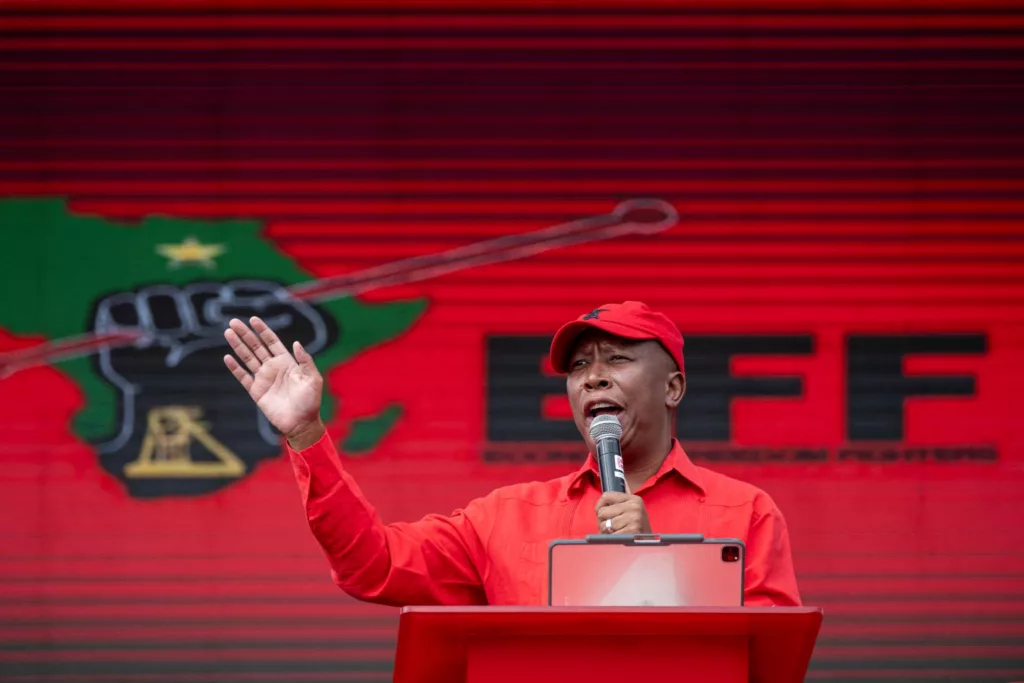
For years, the battle between Julius Malema, the EFF, and AfriForum has been fought through political speeches, protests, and increasingly, the courts.
Now, another chapter is opening.
AfriForum has approached the High Court in Pretoria seeking to have EFF leader Julius Malema and the Economic Freedom Fighters (EFF) found in contempt of court over what the organisation says are renewed calls for people to occupy land unlawfully.

And AfriForum is not asking the court for a slap on the wrist.
The organisation wants the EFF fined R500,000 and Malema sentenced to 18 months in prison, or for the court to impose another appropriate sanction.
There is, however, an important distinction.
Those are penalties AfriForum is asking the court to impose. They are not sentences that have already been handed down.
The court must still consider the application and decide whether contempt has been established.
A Seven-Year-Old Court Order Is Back In The Spotlight
At the heart of the dispute is a court order dating back to 2017.
The order prohibits Malema and the EFF from inciting, encouraging, ordering or recruiting people to enter land without the necessary permission of the owner or lawful occupier.
That order did not simply disappear with time.
Malema and the EFF have repeatedly tried to have it overturned. Those attempts have taken the dispute through several levels of South Africa’s courts, including the Constitutional Court and the Supreme Court of Appeal.
The challenges ultimately failed.
That history gives the latest application a different character.
This is not simply a fresh disagreement between a political party and a civil rights organisation over land reform. AfriForum’s argument is that there is already a binding court order — and that Malema and the EFF know what it says.
The question now is whether they have crossed the line drawn by that order.
The Words That Put The Case Back In Court
The latest application follows comments attributed to Malema during a public lecture at the University of Limpopo.
Malema was discussing the stark contrast between people living in crowded township communities and large areas of land nearby.
He described a property in the Stellenbosch area with a single house occupying thousands of hectares.
Then came the part that AfriForum says is central to its case.
Malema recounted telling people in Kayamandi that they should take and occupy the land.
He also spoke about a future generation entering a farm in Stellenbosch.
For supporters of the EFF, such rhetoric sits within a much broader argument about land ownership, historical dispossession, and economic inequality.
For AfriForum, the context does not change the legal problem.
The organisation says Malema is making precisely the kind of call that the 2017 court order prohibits.
And that is where political rhetoric meets the rather less forgiving language of a court order.
Is Calling For Land Reform The Same As Calling For Land Occupation?
This is where the issue becomes more complicated than a political shouting match.
South Africa’s land question is real. Historical dispossession, unequal land ownership, and the demand for meaningful land reform remain deeply contested issues.
Political parties have every right to argue about those questions.
But there is a difference between demanding land reform through legislation and encouraging people to enter somebody else’s property without permission.
The latest case, therefore, isn’t necessarily asking the court to decide whether South Africa needs land reform.
It is asking something considerably narrower:
Did Malema and the EFF breach a court order by encouraging unlawful occupation?
That distinction could prove critical.
The Court Has Heard This Argument Before
The 2017 order has already survived years of legal challenges.
Malema and the EFF attempted to overturn it, with those efforts reaching the country’s highest courts.
A High Court application for leave to appeal was dismissed in January 2023. The Constitutional Court subsequently dismissed an application for leave to appeal in March 2023, while the Supreme Court of Appeal rejected another attempt in June of that year.
A further Constitutional Court application was dismissed in September 2023.
In other words, the order has not simply been sitting in a legal filing cabinet gathering dust.
It has been challenged.
And it survived those challenges.
That could make the latest proceedings particularly interesting because AfriForum can point to a lengthy history showing that Malema and the EFF were aware of the restrictions.
AfriForum Wants Tough Consequences
AfriForum CEO Kallie Kriel says the EFF and Malema know exactly what the order says and have spent years attempting, unsuccessfully, to have it overturned.
The organisation now wants the court to hold them accountable.
Its requested sanctions are significant:
- R500,000 fine for the EFF
- 18 months’ imprisonment for Malema
- Or another sanction the court considers appropriate
Whether the court agrees is another matter entirely.
A contempt application still has to satisfy the legal requirements for contempt. The existence of a controversial statement, or even a video recording of it, does not by itself mean a court will automatically impose the punishment being sought.
That decision belongs to the judge.
What About The Video Evidence?
The dispute has also generated considerable commentary around publicly available video footage of Malema’s remarks.
Commentator Renaldo Gauws, discussing the case on YouTube, argues that the evidence is particularly significant because footage of Malema making the relevant remarks was published through the EFF’s own online channels.
That is an interesting point, but it should not be confused with a legal conclusion.
A video can provide evidence of what somebody said.
The court must still determine what those words mean in the context of the existing order and whether they satisfy the legal test for contempt.
That distinction matters.
Calling something a “slam dunk” may make for compelling commentary. It is not the same thing as a court judgment.
Malema Has Other Legal Problems Too
The contempt application arrives at an already difficult time for Malema.
He is separately appealing a five-year direct imprisonment sentence arising from a firearm-related case.
The KuGompo Regional Court convicted Malema in that matter and imposed a five-year sentence in April 2026. Leave to appeal the sentence was granted, while leave to appeal the conviction was initially refused. Malema has subsequently pursued further legal avenues in an attempt to challenge both the conviction and sentence.
That matter is separate from AfriForum’s contempt application.
The distinction is important because political commentary can easily turn several separate court cases into one giant narrative about a politician’s downfall.
The legal reality is more complicated.
Each case has its own facts, evidence, and appeal process.
The Bigger Battle Is About More Than Julius Malema
Strip away the personalities, political slogans and social media arguments, and something rather important remains.
South Africa has to find a way of dealing with its unresolved land question.
At the same time, the country has a legal system in which court orders are supposed to mean something.
Those two realities can collide.
Someone can passionately believe that South Africa’s land ownership patterns need to change while also accepting that private property cannot simply be occupied whenever a political leader calls for it.
Equally, defending property rights does not automatically settle the broader question of whether the country’s land reform programme has been effective.
Both questions can exist at the same time.
And perhaps that is why this case deserves more attention than another round of political point-scoring.
What Happens Next?
The High Court now has to consider AfriForum’s application.
If the court finds that Malema and the EFF breached the existing order and that the requirements for contempt have been satisfied, the consequences could be serious.
If it does not, AfriForum’s requested sanctions will not simply become sentences because the organisation asked for them.
Until the court rules, there is a temptation for both sides to fill the gap with their own version of events.
One side can portray the proceedings as an attack on land reform and political speech.
The other can portray them as a straightforward case of a political leader ignoring a court order.
The truth, as it so often does, will depend on the evidence and the legal findings.
And that leaves some uncomfortable questions worth asking.
How far can a political leader go when advocating radical land reform before that advocacy becomes unlawful incitement?
If a court order has survived multiple appeals, how seriously should political leaders be expected to take its restrictions?
And perhaps the biggest question of all: when political conviction comes up against the rule of law, which one should ultimately prevail?