Challenges to Judicial Impartiality
Rich in wisdom, experience and perspective, though Professor Karthy Govender’s address to law school graduates was (Post May 20 -24), it is a pity that, like others, he glosses over the fact that the liberties of the constitution have facilitated exploitation and that its commitment to non-racialism is so compromised as to be meaningless.
He states that “it is a non-sequitur for our constitutional democracy to be blamed for the malfeasance and misconduct of senior public officials.” Yes, that should be the case, but by adhering to the premise that persons previously disadvantaged should enjoy priority, the constitution downplays merit as a necessary credential.
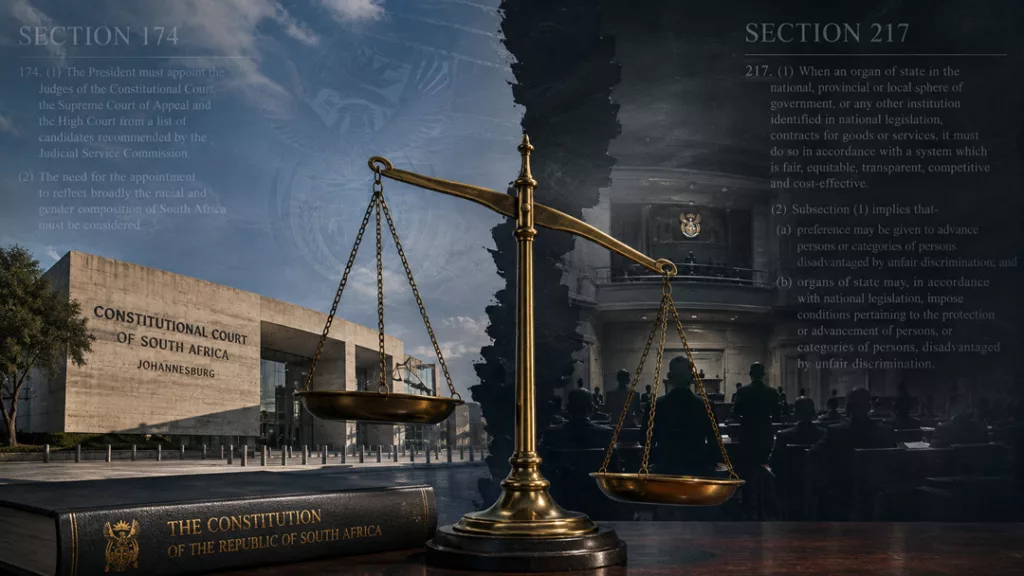
Consider the following sections of the Constitution. While 174(1) specifies the appointment of “appropriately qualified” persons to the judiciary, section 174 (2) requires that those appointments “broadly reflect racial and gender composition.” The same criteria apply in the appointment of commissions – section 193 (1 & 2). Section 195 (1) (i), concerning public administration, has the added proviso “to redress the imbalances of the past.”

Where merit goes right out of the window is in section 217, which concerns contracts for the procurement of goods and services. Subsections (2a & b) openly provide for “preference” and “protection” for the “advancement of persons disadvantaged by unfair discrimination.”
Those references have proved the gateway for the installation of cadres whose loyalty is to a political entity. As a result, faith and hope in the system of governance have suffered because malfeasance has flourished. It’s all very well for Professor Govender to state that “merit needs to play an appropriate role in appointments,” but that simply is not what is occurring because after 30 years, merit has come to mean obeisance to ideology and political loyalty.
Sections 195 and 217 have actually served to fast-track skills out of public administration, taking with them institutional memory and resulting in the elevation of mediocrity, maladministration and dysfunctionalism at all levels of government.
Given his perspicacious outlook on the constitution, it is disappointing that Professor Govender does not see fit to call for a revision of those sections which refer to the “previously disadvantaged.” After all, those words should not apply to persons born since the constitution came into being in 1996. But now they apply to those born since 1996 who belong to the race regarded as previously advantaged, who are now disadvantaged based on historical circumstances they had nothing to do with. Where is the non-racialism in that treatment?
While there is merit in the Professor’s praise for the way the judiciary has discharged its responsibilities, in one respect, its “measured jurisprudence” is controversial if not outright lacking. That concerns its finding that Julius Malema’s exhortation to “kill the boers” and his intention to “slaughter whites” at some future time does not constitute hate speech.
That finding defies logic and is totally unworthy of respect. Yet eight years ago, for hate speech, Vicky Momberg was subjected to two years’ imprisonment for using the ‘k’ word in an emotional outburst.
A significant aspect which would have been refreshing for Professor Govender to consider is the Judicial Services Commission. How does he feel about Julius Malema being one of the six parliamentary representatives who are part of the Commission’s membership of 23?
Moreover, looking ahead at the survival of the impartiality of the judiciary, how does Professor Govender relate to Malema’s blatant disregard of his conviction by Magistrate Twanet Olivier and his vitriolic intimidation of her? Surely, he should be removed from the Judicial Services Commission? Where is the will of the judiciary to express firm, outspoken support for Magistrate Olivier for discharging her responsibility?
In considering the challenges of constitutional democracy, Professor Govender ought to have warned law graduates of the peril that political intimidation poses to the future impartiality of the judiciary.