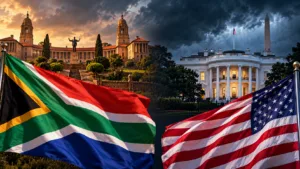
Congress Moves Forward on South Africa Sanctions

Washington, D.C. – In a historic and highly symbolic move, the U.S. House of Representatives has advanced H.R. 2633, the U.S.–South Africa Bilateral Relations Review Act of 2025, through committee, signaling what may become a tectonic shift in American foreign policy toward Pretoria.
Introduced by Rep. Ronny Jackson (R-TX) and co-sponsored by Rep. John James (R-MI), the bill demands a full review of the U.S.–South Africa relationship and provides President Trump with explicit authority to sanction corrupt South African officials and entities seen as undermining U.S. interests.
“The days of allowing our so-called ‘allies’ to walk all over us are OVER!”
– Rep. Ronny Jackson, X.com, July 22, 2025
The bill’s justification is damning: it accuses South Africa of abandoning its Western alliances in favor of authoritarian regimes and state sponsors of terror—specifically China, Russia, Iran, Hamas, and Hezbollah. According to the bill, these alliances have not only compromised U.S. national security but have also made a mockery of nearly $8 billion in U.S. aid delivered to South Africa over the past two decades.

South Africa made its choice when they abandoned America and our allies and sided with communists and terrorists.
Today, my bill to fully review America’s relationship with South Africa and give President Trump the tools necessary to hold their corrupt government accountable…
— Ronny Jackson (@RepRonnyJackson) July 22, 2025
What the Bill Targets
The legislation lists 14 egregious acts by the ANC government, including:
-
The “Lady R” scandal, where Pretoria allegedly refused U.S. diplomatic requests regarding arms exports to Russia.
-
Military exercises with Russian and Chinese forces while Ukraine remained under attack.
-
Training of Chinese PLA pilots by ex-U.S. and NATO personnel in South Africa.
-
Anti-Israel posturing at the ICJ, while remaining silent on China’s Uyghur persecution, Ethiopian war crimes, and the Rohingya genocide.
The bill also criticizes South Africa’s internal failures, including corruption at Eskom and Transnet, the state’s handling of cholera outbreaks, and the controversial appointment of Ibrahim Rasool, a known critic of the U.S. and President Trump, as ambassador to Washington.
What’s Next?
Now that H.R. 2633 has passed through committee, it will move to the House floor for debate and voting. With Republicans in control, it is widely expected to pass—potentially with bipartisan support.
If passed by the House and subsequently the Senate, the bill will land on President Trump’s desk, where signature is likely guaranteed. Once enacted, it could pave the way for:
-
Targeted sanctions under the Global Magnitsky Act.
-
A reclassification of South Africa’s ally status.
-
Suspension or redirection of U.S. aid programs.
South Africa’s Response?
As of now, there has been no official response from Pretoria, but the ANC and allied media are expected to frame the bill as “racist” or imperialist in tone. However, critics point out that Rep. John James, one of the bill’s co-sponsors, is African-American, undermining those accusations.
The move is part of a broader campaign by the Trump administration to reassess and penalize nations that “speak from both sides of their mouth” while benefitting from U.S. largesse.
Editorial Insight
For many who watched South Africa’s post-1994 promise dissolve into state capture, patronage, and geopolitical double-dealing, this bill marks a reckoning long overdue. But for those hoping to salvage bilateral diplomacy, this signals the beginning of a frostier, transactional U.S.–SA era.
Will the ANC pivot back toward cooperation—or double down on BRICS and Beijing? And will ordinary South Africans bear the cost of their leaders’ ideological entanglements?